Resources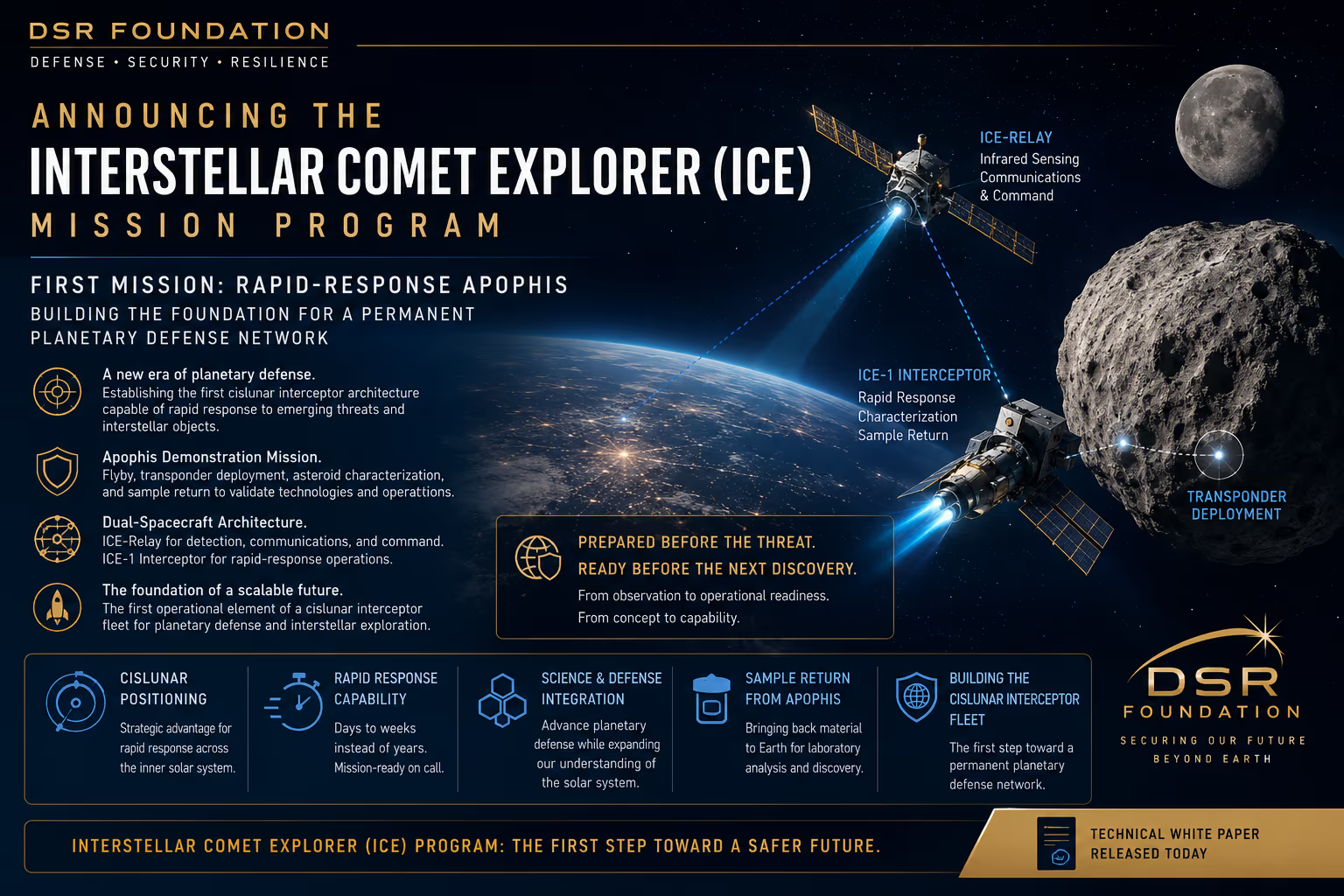
Technical White Paper
Interstellar Comet Explorer Architecture
A Modular Lagrange-Point Sentinel and Interceptor Framework for Interstellar Object Detection and Characterization
Abstract
The confirmed detections of ʻOumuamua, 2I/Borisov, and 3I/ATLAS demonstrated that extrasolar material periodically traverses the inner solar system, creating rare opportunities for direct observation. Current architectures remain poorly positioned to capitalize on such events. This paper proposes the Interstellar Comet Explorer (“ICE”) architecture: a modular deep-space infrastructure concept pairing an infrared L1 sentinel with a scalable family of interceptor-class spacecraft, framed as an early precursor to a broader cislunar and deep-space detection and planetary-defense framework.
What's inside
- An infrared sentinel platform at the Sun–Earth L1 Lagrange point for difficult solar-elongation geometries
- A scalable family of interceptor-class spacecraft for close characterization and sample return
- Integration with NEO Surveyor, Rubin Observatory, Comet Interceptor, and planetary-defense institutions
- The 2029 close approach of 99942 Apophis as a real-world validation campaign
Authors
- James Anthony Wolff — Defense Security Resilience Foundation
- Marshall Eubanks — Space Initiatives Inc.
- Christopher Jannette — Blackstar Orbital Technologies Corporation
- Sean Hollis — Blackstar Orbital Technologies Corporation