Skip to content
S/00Space-risk finance

The technology to stop it exists. The capital doesn't.

We can already deflect asteroids, clear decaying orbits and harden power grids. What no one has built is a standing treasury to pay for it — staged before the next event, not scrambled after.

Why the gap exists The path
Scroll
Deflection capabilityDemonstrated · Sept 2022
Tracked objects in orbit0+
Standing fund committed$0
S/01The problem

Three proven threats. One shared absence.

Each risk below has a demonstrated mitigation pathway and settled scientific consensus. None has a funded instrument behind it.

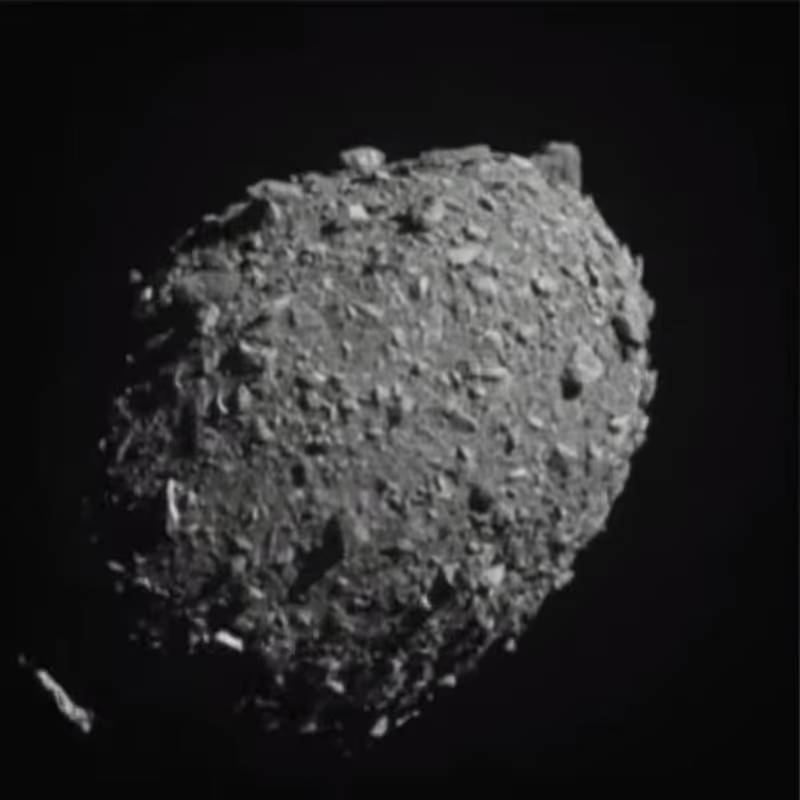
Asteroid moonlet Dimorphos photographed by NASA's DART spacecraft before impact
Dimorphos · NASA / Johns Hopkins APL
01 — Planetary defenseDeflection proven

Asteroid & comet impact

Deflection needs three to ten years between decision and intercept. Money committed after detection arrives after the window shuts. Pre-positioned capital isn't a preference here — it's orbital mechanics.

3–10 yrs
Lead time required
33 min
Orbit shift achieved
$0
Standing fund
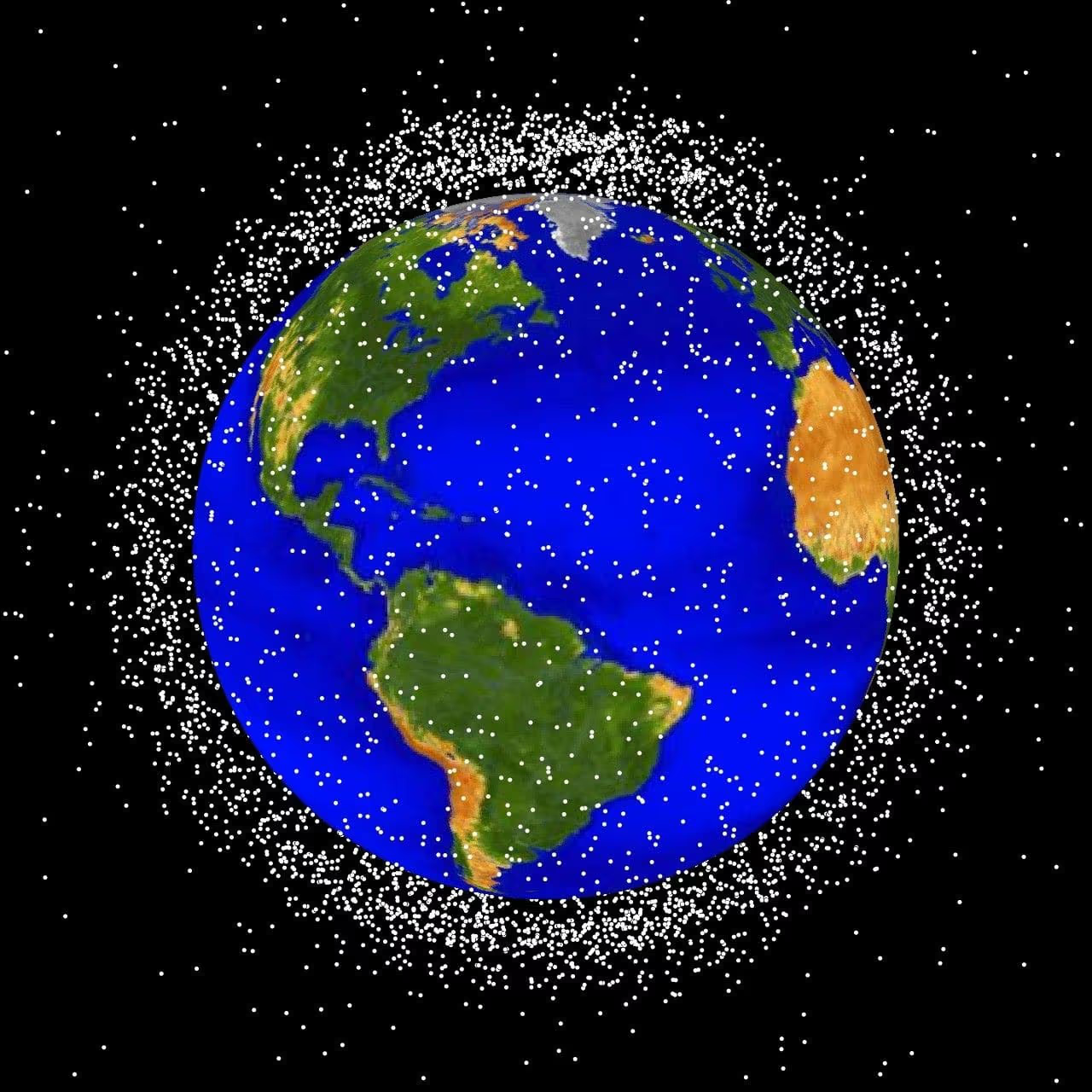
Computer-generated map of tracked debris objects in low Earth orbit
Tracked debris, LEO · NASA ODPO
02 — Orbital debrisRemoval demonstrated

Collision cascade in low Earth orbit

Every collision makes thousands of fragments, each able to cause the next. Removal hardware has flown and worked. What has never existed is funded capacity to operate it at the rate the cascade demands.

27,000+
Objects tracked
~3 / day
High-risk conjunctions
$0
Removal capacity funded
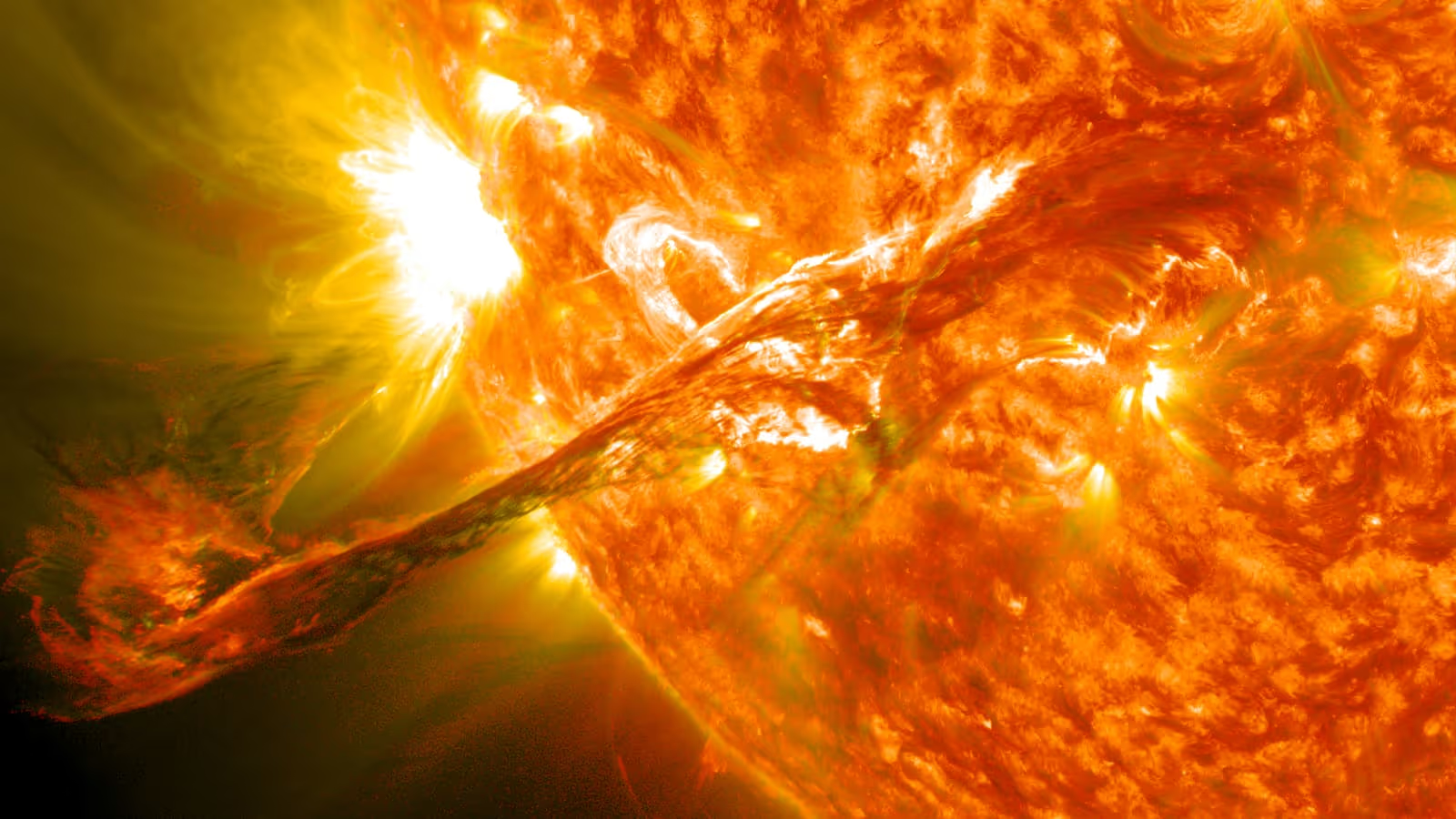
A coronal mass ejection erupting from the Sun, imaged by NASA's Solar Dynamics Observatory
Coronal mass ejection, 2012 · NASA GSFC
03 — Solar & geomagneticPrediction advancing

Carrington-class geomagnetic storm

A severe storm could damage hundreds of extra-high-voltage transformers at once. Each replacement takes twelve to eighteen months to build, and no reserve inventory is financed anywhere in the world.

12–18 mo.
Transformer lead time
~11 yrs
Solar cycle period
$0
Resilience treasury
S/02Proven capability

The engineering is operational. The balance sheet is empty.

Every domain has flown hardware, published results and an international coordination body. None has a financial counterpart.

Dimorphos surface imaged by the DART spacecraft
DART terminal approach · NASA / JHU APL

In September 2022 NASA's DART spacecraft changed the orbital period of the asteroid Dimorphos by kinetic impact. Detection, characterisation, intercept and coordination now form an operational chain.

33 min

Orbital period change achieved — twenty-five times the threshold set for mission success.

Mission dossier
2022DARTFirst kinetic deflectionConfirmed
2028NEO SurveyorSpace-based detectionLaunching
TBDESA RAMSESApophis rendezvousProposed
2016IAWN / SMPAGInternational coordinationActive
$0Zero transactions. Ever.
  • No standing fund
  • No response treasury
  • No pre-approved deployment
  • No cost-sharing framework
S/03Why the gap exists

This is not an engineering failure. It is a finance failure.

Three structural reasons the money has never been staged. All three are fixable — which is the point.

01

No owner

An asteroid on an Earth-crossing orbit belongs to no jurisdiction. Prevention benefits everyone and bills no one, so every actor can rationally wait for another to pay. Nothing gets funded by default.

02

No matching timeline

Deflection needs a decade of lead time. Appropriations run a year; political mandates run four. Public finance has no standard vehicle for holding capital that long against an event with no date on it.

03

No instrument

Catastrophe finance prices risk from actuarial history. A once-in-many-generations event has no loss table, so the market has never written the paper — even where the engineering response is well understood.

Every one of these is a problem of design, not of physics.

S/04Dedicated fund for space-origin threats
$0

Not a rounding error. The literal balance.

Catastrophe finance by instrument, approximate figures in US dollars
World Bank catastrophe bonds issued to date4.8 billion
FEMA disaster relief fund, annual appropriation3.4 billion
Satellite insurance market, annual premiums700 million
Dedicated fund for space-origin threats0

Sources · World Bank IBRD catastrophe bond issuance · FEMA Disaster Relief Fund appropriation · published satellite insurance market estimates. Figures are approximate, shown for order-of-magnitude comparison.

S/05Critical windows

Three clocks are already running.

Converging timelines where the absence of financial architecture — not technology — becomes the binding constraint.

Global attention windowT-minus
13 April 2029

Asteroid 99942 Apophis passes closer to Earth than our geostationary satellites — visible to the naked eye across Europe, Africa and western Asia.

31,600 km
Closest approach
~340 m
Diameter
Ruled out
2029 impact risk
~2030

Cascade threshold

The projected point at which collision cascading in the most congested LEO shells becomes self-sustaining without active removal.

Will the removal capacity be funded?
~2036

Solar Cycle 26 maximum

Every eleven-year cycle carries Carrington-class risk. Hardening has to be financed and built during the quiet years.

Will the grid be hardened in time?
Now

The decision window

Chartering an institution and issuing its first instruments takes years. The build starts before the event, or it doesn't matter.

Will the architecture exist?
S/06The architecture

Not new mechanisms. Proven ones, extended.

Catastrophe finance already moves billions for terrestrial risk. The work is to point those instruments at space-origin threats and give them a standing home.

01

The DSR Bank

A multilateral institution holding pooled space-risk defence capital. GDP-weighted contributions fund deflection, removal and hardening from one treasury under one governance line.

Modelled on GEF · GFDRR
Read proposal
02

Space Risk Bonds

Capital-markets instruments structured per threat profile: deflection-timeline bonds, removal-capacity bonds, and resilience-linked bonds tied to measurable hardening milestones.

Mechanism · World Bank cat bonds
View structure
03

Global Governance

A transparent framework with scientific oversight spanning COPUOS, the ITU and national grid authorities, so capital can be released across orbital and terrestrial domains without a new treaty round.

Compatible with COPUOS · ITU norms
Explore framework
S/07The path

Three phases. The first one starts now.

A proposed sequence, staged so that capital is in place before the 2029 attention window rather than after it.

Charter

Phase 01 · 2026–27

Draft the legal instrument, convene founding members, and define governance with independent scientific oversight. Nothing can be capitalised before it can be governed.

Capitalise

Phase 02 · 2027–29

Convert commitments into staged capital: GDP-weighted contributions alongside a first bond issuance, sized against the deflection lead times rather than the news cycle.

Operate

Phase 03 · 2029 onward

A standing treasury with pre-approved release criteria across all three domains, audited annually and reported publicly. Ready before it is needed — the only condition that counts.

Status

The foundation is in Phase 01. Founding-member conversations, governance drafting and technical costing are open now.

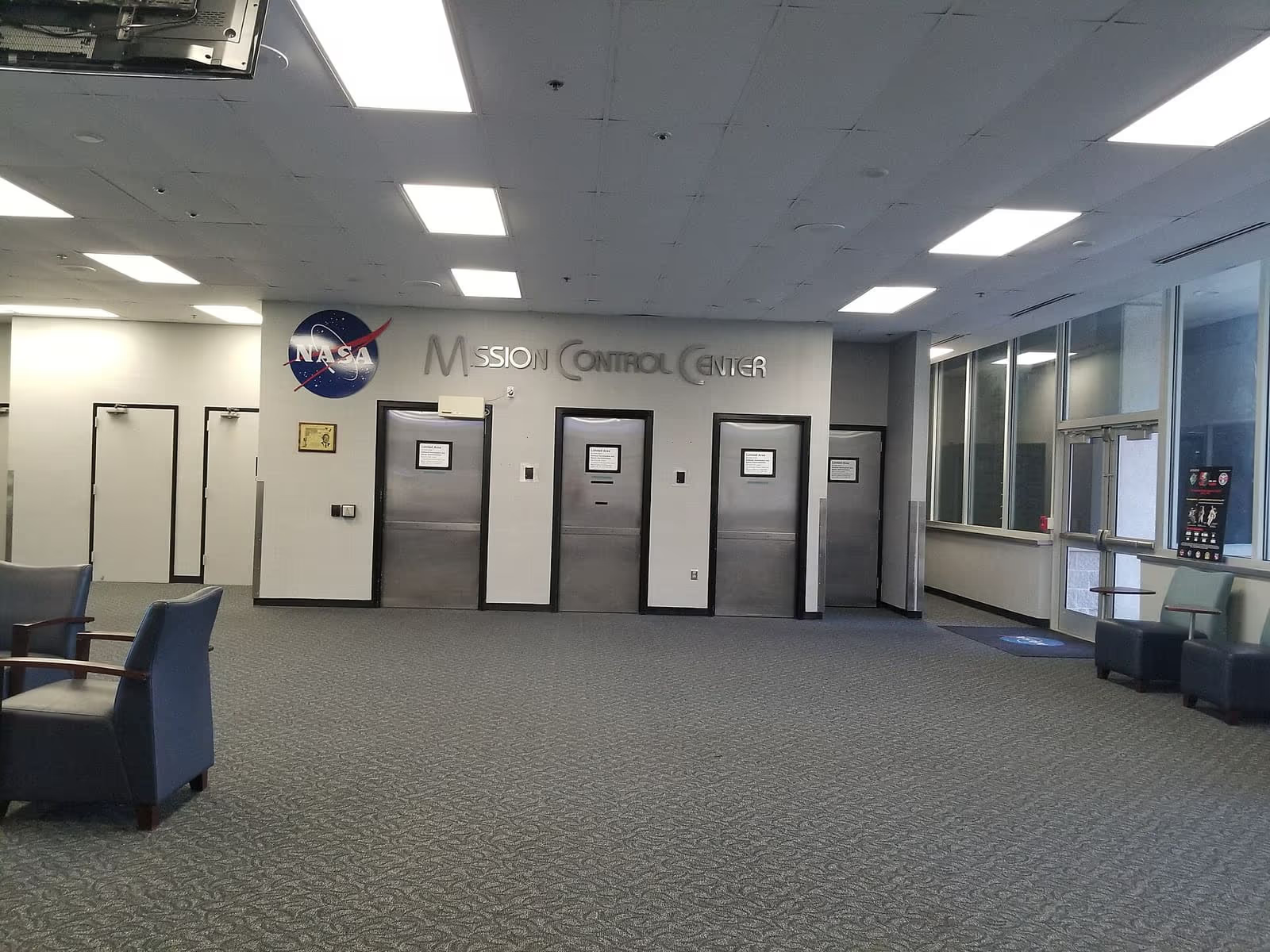
Flight controllers at consoles in a mission control centre
S/08 · ParticipateThe response gets planned in rooms like this. It gets paid for long before.
Start the conversation

Pick the track closest to your role.